Fake Silver & Gold Are Flooding eBay and Marketplaces: How to Spot Counterfeits and Avoid Costly Mistakes.
Fake Silver & Gold Are Flooding eBay and Marketplaces
Educational content only. Not financial or legal advice.
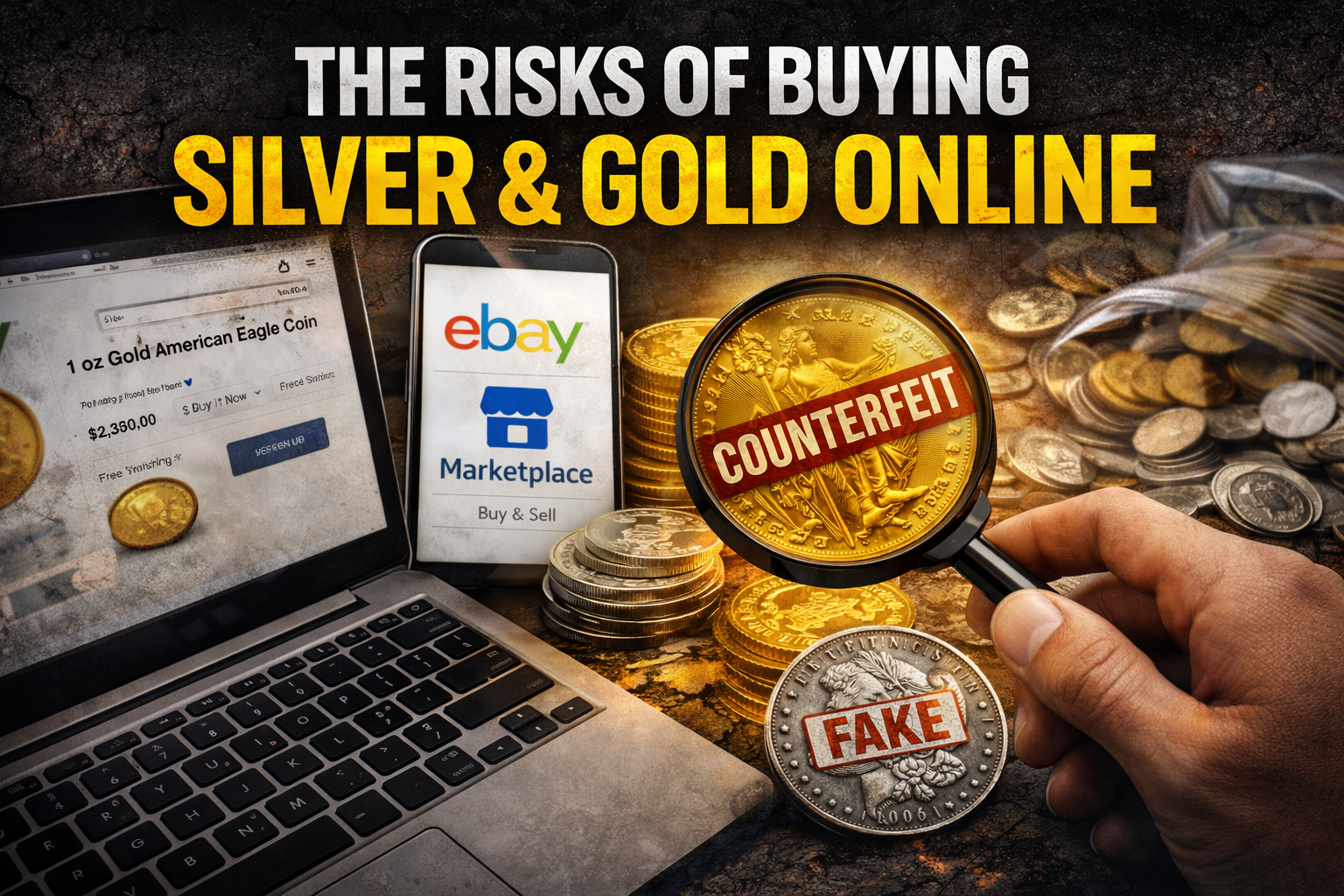
Shopping for silver and gold online feels convenient: endless listings, “deals,” and the promise of bullion or estate jewelry delivered to your door. The problem is that precious metals are one of the most targeted categories for fraud—because they’re high-value, easy to ship, and hard to authenticate from photos alone. U.S. authorities have warned that counterfeit bullion and collectible coins are actively being sold on online auction sites and social platforms, and that many buyers spend significant money only to receive near-worthless counterfeits.
This post breaks down why eBay and person-to-person marketplaces are risky for silver/gold purchases, how counterfeits have evolved into “good fakes,” and the practical steps you can take to reduce your odds of getting burned—backed by real cases and primary sources.
Fake Silver & Gold Are Flooding eBay and Marketplaces
The core issue is information asymmetry: sellers can describe an item however they want, while buyers often cannot verify metal content, weight accuracy, or authenticity until the item arrives—or until they meet in person. The Federal Bureau of Investigation (FBI), through its Internet Crime Complaint Center (IC3), has explicitly warned that counterfeit coins and bullion—including silver and gold products—are widely sold through online auctions, social media marketplaces, and retail websites, targeting both investors and collectors.
Even when a platform bans counterfeits, enforcement is not perfect at internet scale. For example, eBay’s own rules prohibit “replica or counterfeit bullion” and require listings to accurately state precious metal weight content, fineness/purity, and brand, with photos of both sides of the actual item being sold—yet counterfeit listings still appear and are reported by buyers and industry groups.
Person-to-person marketplaces increase risk even further because transactions often happen outside a formal checkout system. The Federal Trade Commission (FTC) warns that scammers commonly pressure buyers to pay outside a marketplace’s payment system—where consumer protections are lost. The FTC also highlights classic red flags such as prices that are far below market value for precious metals, urgency tactics, and sellers who refuse verifiable documentation.
There is some improvement on the policy side: the FTC notes that the INFORM Consumers Act was designed to deter criminals on marketplaces (including sellers of counterfeit goods) and requires disclosures and reporting mechanisms for certain “high-volume” third-party sellers. Helpful—but it does not eliminate the risk for precious metals, especially when you’re dealing with small sellers, local meetups, or off-platform payment requests.
Fake Silver & Gold Are Flooding eBay and Marketplaces
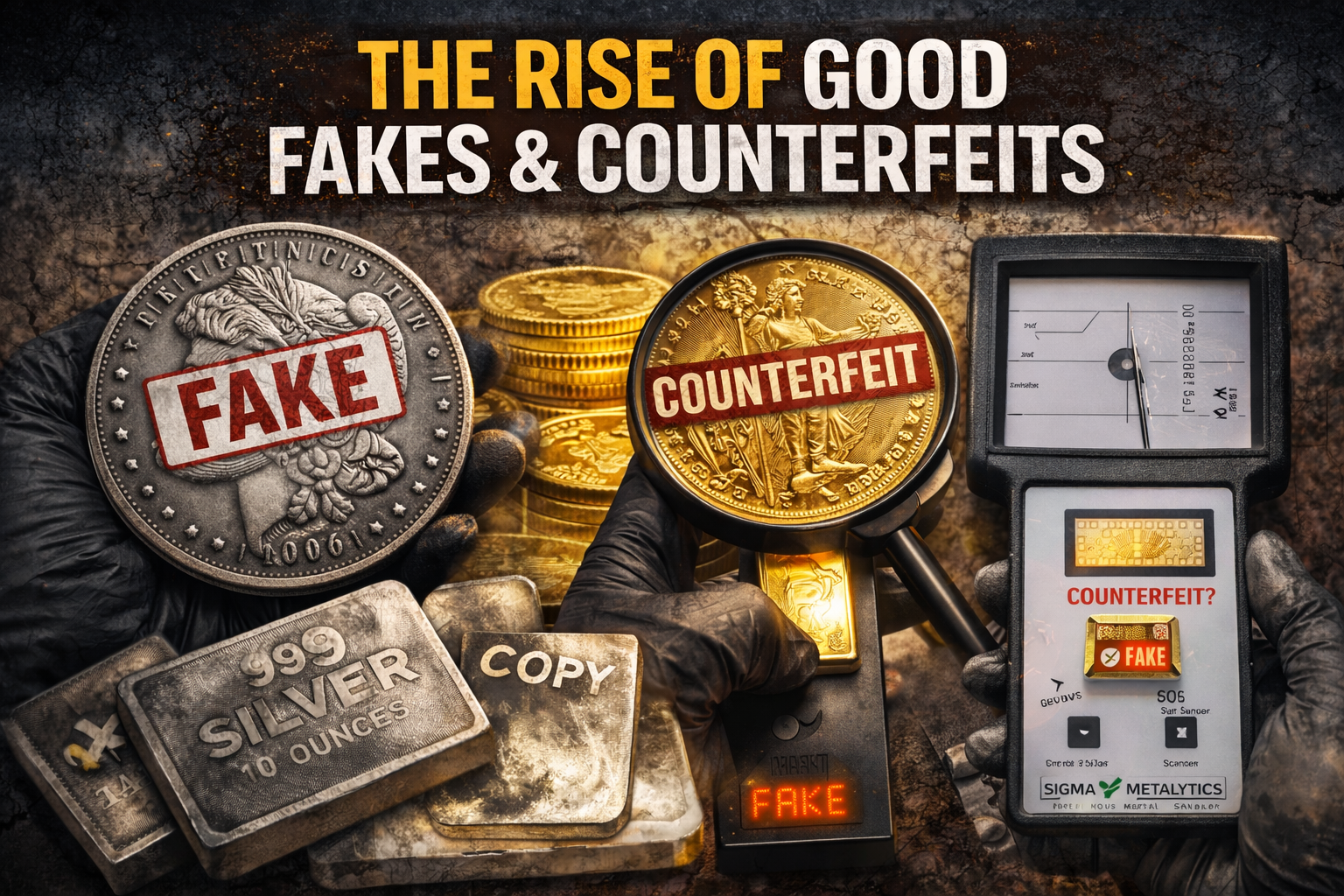
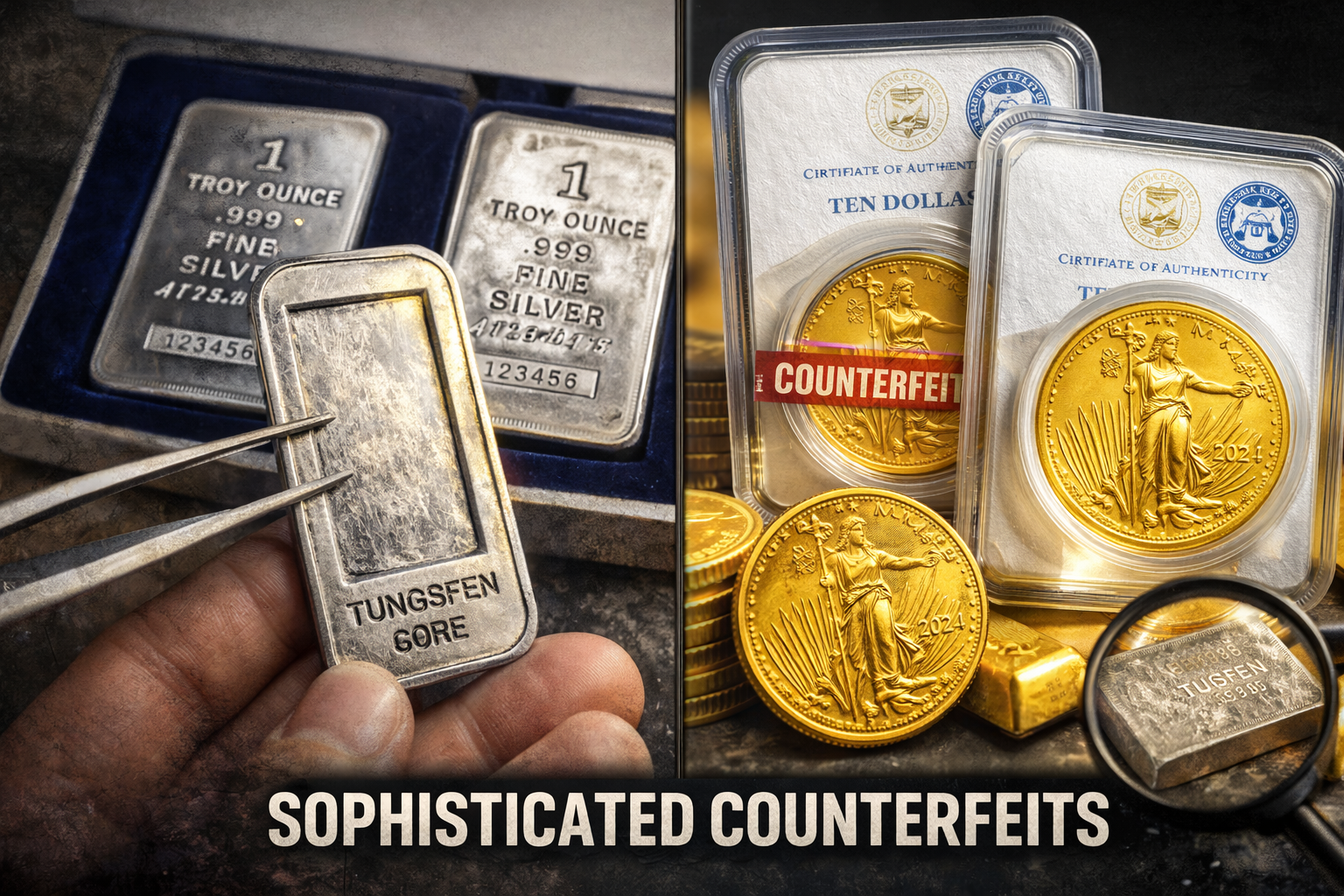
A decade ago, many counterfeits were crude: obviously wrong color, sloppy details, magnetic base metal, or laughably incorrect weight. Today’s problem is different. Industry and law enforcement reporting increasingly emphasizes sophisticated counterfeits—items that can look correct in photos, mimic legitimate packaging, and sometimes even use the “right” metal.
Here are major “modern counterfeit” patterns buyers should understand:
Counterfeit coins made with real silver. Some of the most dangerous counterfeits today are struck in real silver. The Professional Coin Grading Service (PCGS) has documented deceptive counterfeit coins made from genuine silver that still fail authentication due to incorrect design details, improper mintmark characteristics, or subtle engraving errors—exactly the kind of “good fake” that can ambush buyers who rely on quick visual checks or assumptions like “it’s common, so it wouldn’t be faked.”
Fake or manipulated “graded” holders (slabs). Counterfeiters don’t just fake the coin—they fake the plastic holder and label too. PCGS has warned that counterfeit PCGS holders have appeared in online auctions, and that criminals have even reused legitimate certification numbers. In these cases, the serial number may appear valid online, but the coin inside the holder is not authentic—making “the number checks out” an incomplete test by itself.
Authentic holders used for a coin-swap (“bait-and-switch”) scheme. The Numismatic Guaranty Company (NGC) has pursued litigation describing schemes in which genuine NGC-certified coins were removed and replaced with inferior or counterfeit coins. The holders were then resealed and sold as if they still contained the original certified items. In other words, sometimes the “slab” looks real because parts of it are real.
High-quality minted-bar counterfeits and convincing packaging. Industry presentations from LBMA-affiliated refining conferences warn that internet purchases from unknown sellers raise the risk for counterfeit minted bars. Sealed or tamper-evident packaging—while intended to protect integrity—can actually hinder verification, allowing high-quality fakes to slip into retail markets before being detected.
Tungsten-based gold fakes, engineered for density. One reason “gold bar fakes” can be scary is material science: tungsten has a density that closely matches gold, and industry sources explicitly note counterfeiters exploit this—making weight-based checks less reliable unless combined with other testing.
“Real gold, fake brand” bars. A Reuters investigation described a subtle but serious fraud type: gold bars in which the metal itself assays as genuine, high-purity gold, but the markings or branding are forged. Refiners have warned that these fakes can be highly professional and increasingly sophisticated—creating risks not only for individual buyers, but also for supply-chain integrity, including laundering and traceability concerns.
These risks are one reason major institutions invest heavily in security and traceability systems. For example, the London Bullion Market Association (LBMA) describes “Gold Bar Security Features” as part of its Gold Bar Integrity initiative, which is designed to strengthen identity verification and traceability across the global gold supply chain.
Likewise, the Royal Canadian Mint employs proprietary authentication systems such as Bullion DNA for certain Maple Leaf bullion products. These systems use micro-engraved security marks and database matching through authorized dealers. The existence of such measures is itself a signal: counterfeiting pressure is real enough that top mints and market bodies actively engineer around it.
Fake Silver & Gold Are Flooding eBay and Marketplaces
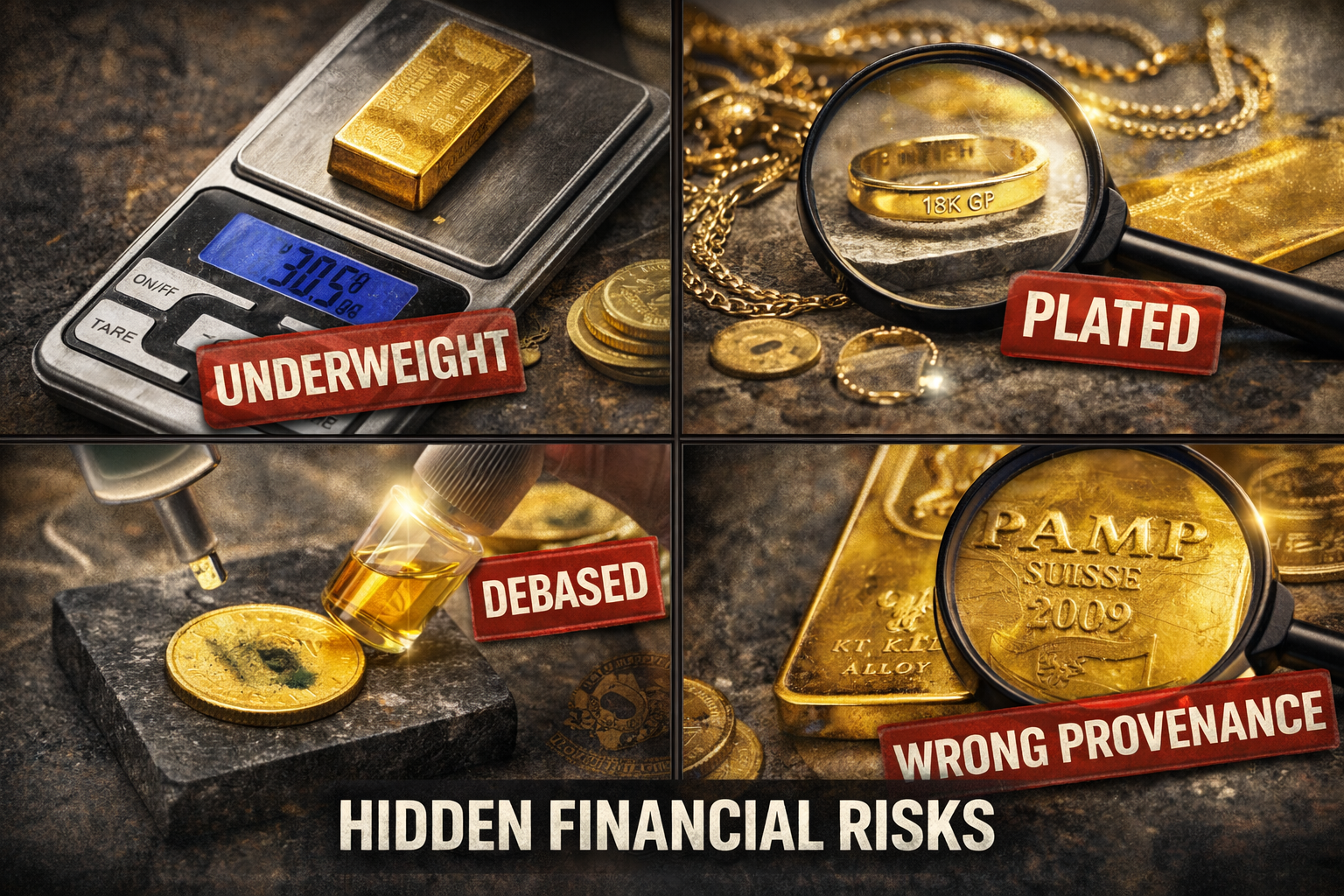
Financial loss (and not always in an obvious way). Your risk isn’t just “pay $2,000, get a $20 fake.” It can be more subtle: underweight bars, debased alloys, plated jewelry sold as solid, or “real gold but wrong provenance/branding” products that are difficult to resell through reputable channels.
Liquidity risk: reputable buyers test, and informal sellers disappear. If you buy privately and later discover the item is counterfeit, you may have no practical path to recover funds—especially if the seller used a fake identity or pressured you into cash or off-platform payment. Even experienced buyers can struggle: a Minnesota law-enforcement-linked report warned that even individuals with experience buying and selling gold and silver may be unable to detect counterfeits without professional testing.
Personal safety risk in meetups. High-value trades can lure people into unsafe locations. In one reported case, a buyer met a seller in a back alley to purchase “gold bars” totaling $21,000, only to later learn they were fake—prompting public warnings and recommendations to meet at reputable dealers for on-the-spot testing.
Legal exposure if you knowingly resell a counterfeit. In the U.S., federal law can criminalize selling or possessing counterfeit “coin or bar” knowing it is counterfeit and acting with intent to defraud (18 U.S.C. § 485). Said plainly: finding out something is fake and trying to “pass the problem to someone else” can create serious legal consequences.
Jewelry-specific deception: “gold,” “silver,” and plating terms are often misused. The FTC’s consumer guidance explains that gold jewelry terms like “gold filled,” “gold overlay,” and “rolled gold plate (RGP)” refer to a layer mechanically applied to base metal—and that plating thickness and labeling matter. It also notes that “silver,” “sterling,” and “sterling silver” represent 92.5% pure silver (often marked “925”), and that quality marks should be backed by an accountable name or registered trademark. In other words: stamps and buzzwords by themselves are not a guarantee.
From a regulatory standpoint, FTC guidance also makes clear that misrepresenting gold content, karat fineness, or the nature of gold plating/coating is considered unfair or deceptive. That’s enforcement language—not just “buyer beware.”
Fake Silver & Gold Are Flooding eBay and Marketplaces
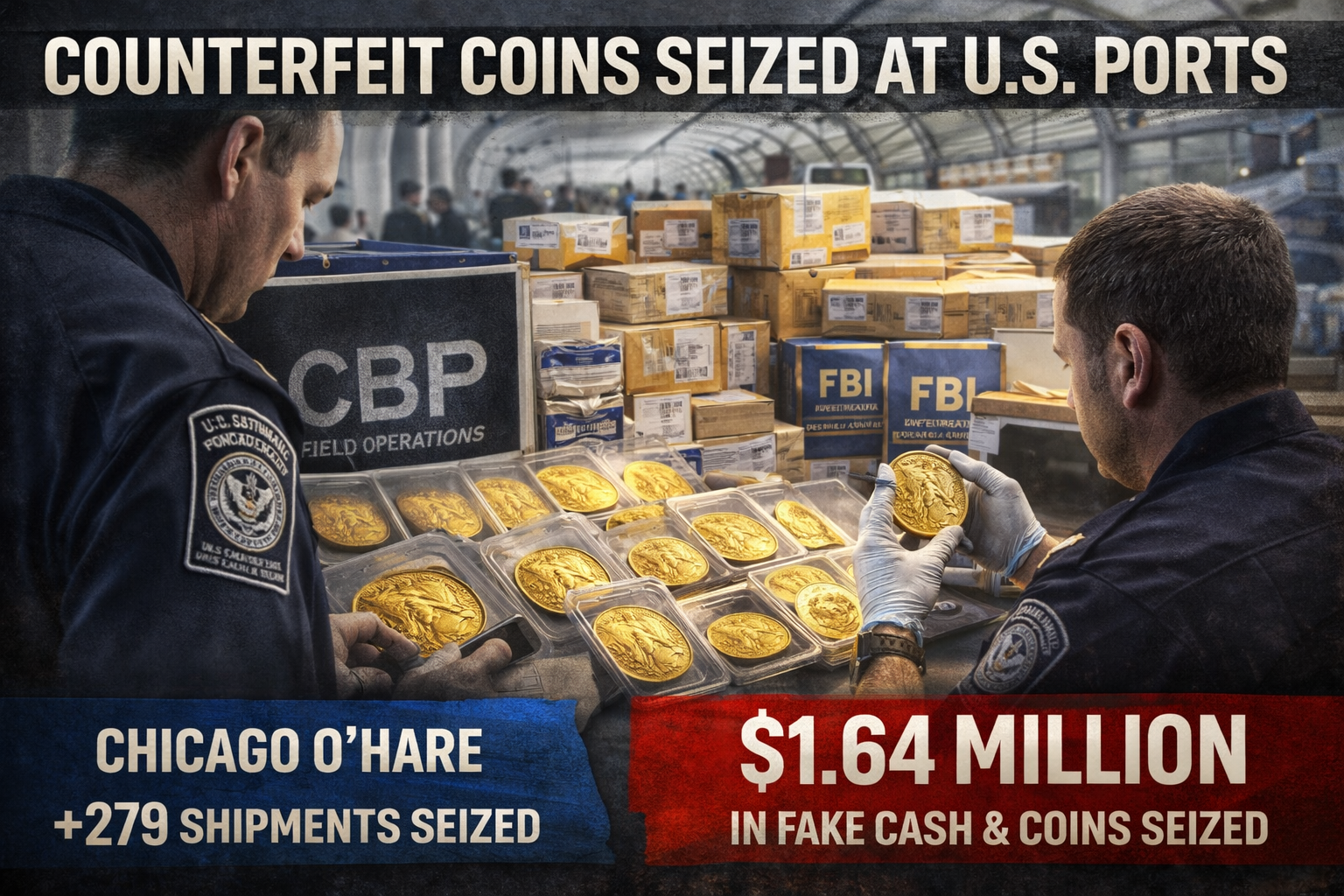
Counterfeit coins flooding mail and ports of entry. Public warnings from the FBI’s Internet Crime Complaint Center (IC3) have cited increasing seizures of counterfeit coins at U.S. ports of entry. In one example, U.S. Customs and Border Protection officers in Chicago intercepted hundreds of shipments from China containing counterfeit coins and currency. In another reported figure, more than $1.64 million in counterfeit cash and coins were seized at Chicago O’Hare International Airport in 2020 alone.
A multi-state counterfeit gold and silver scheme advertised on Facebook Marketplace. The U.S. Department of Justice described a case in which counterfeit precious metals—gold and silver coins and bars—were advertised for sale on Facebook Marketplace, often with claims of pricing below market value. According to the DOJ, victims in multiple states paid cash for what they believed were genuine precious metals. Law enforcement became involved after one buyer determined that the bars were counterfeit.
A local “authentic gold bar” meetup that turned out to be fake. In another reported case, a buyer contacted a seller through Facebook Marketplace regarding an “authentic gold bar,” paid approximately $4,150, and later learned the bar was fake after inspection. Police subsequently arrested and charged the suspect, underscoring the risks of in-person cash transactions without immediate verification.
“Back alley bullion” and a $21,000 hit. A Los Angeles-area television news report described a case in which a man in Redlands, California purchased supposed “gold bars” after making contact through Craigslist. The transactions took place in a back alley on two occasions. The buyer later discovered the bars were counterfeit, prompting warnings from authorities to conduct precious-metal transactions only at reputable dealers where immediate testing is available.
Material-science counterfeiting: tungsten-filled bars. In a widely discussed New York incident, gold bars were found to be filled with tungsten rather than solid gold. This method works because tungsten’s density closely matches gold, allowing counterfeiters to pass basic weight checks—especially when buyers rely too heavily on weight alone as proof of authenticity.
Even when the gold is real, the brand can be fake. Investigative reporting has documented cases where forged bar branding—rather than the gold content itself—creates a different kind of risk. These scenarios complicate provenance, compliance, and resale, underscoring that “counterfeit” does not always mean “cheap metal.”
These examples span mail shipments, online auction and social-marketplace listings, and in-person meetups. The repeating pattern is simple: when verification is postponed until “after the deal,” the buyer carries most of the downside.
Fake Silver & Gold Are Flooding eBay and Marketplaces
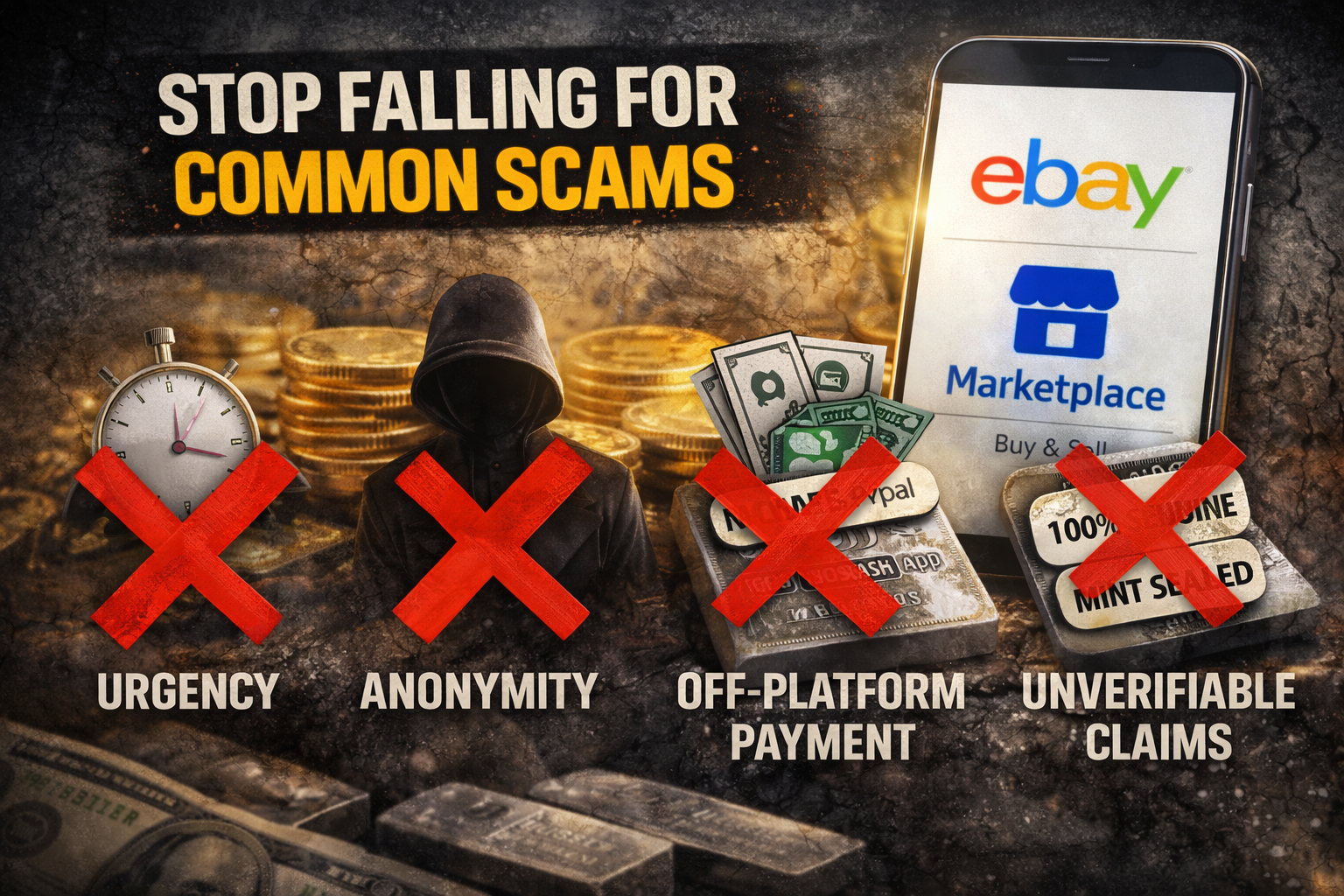
If you still want to buy silver or gold from eBay or social marketplaces, the goal is not “zero risk” (that’s unrealistic). The goal is to stop making the most common mistakes scammers rely on: urgency, anonymity, off-platform payment, and unverifiable claims.
Use the platform’s protections and payment rails (and refuse “workarounds”).
- Don’t pay outside the marketplace payment system; the FTC warns you can lose protections and likely won’t get a refund.
- Avoid payment types that function like cash (wire transfers, gift cards, cryptocurrency) for marketplace purchases.
- Track dispute/return deadlines and keep messages and receipts.
On eBay, treat policy compliance as a minimum—not proof of authenticity.
- Know what eBay requires: accurate purity/weight/brand descriptions and photos of both sides of the actual bullion item. If a listing dodges this, walk away.
- Remember eBay prohibits replica coins and counterfeit/altered coins and currency—yet scams still occur, so you still need your own verification process.
Vet the seller like a professional would. Professional numismatic organizations recommend applying strict checks when buying coins online. These include closely scrutinizing seller feedback ratings, avoiding new or lightly established accounts selling high-value items, being wary of private or hidden feedback histories, and watching for stolen listing photos—a common tactic in which scammers copy images from legitimate dealers to lend false credibility to their listings.
For “graded” coins, verify the certification and compare images—not just the label.
- NGC provides guidance and tools to help buyers check for counterfeit or tampered holders, including verifying certification data and coin images.
- PCGS has warned counterfeiters may use valid certificate numbers, so verifying the number is important—but not sufficient if the holder itself is fake or the coin has been swapped.
For in-person Marketplace meetups, change the setting.
Many costly cases share the same detail: the exchange happened quickly, in an uncontrolled location, and often with cash. Public safety guidance in real cases favors meeting at reputable dealers where the item can be tested immediately, or in safer controlled spaces (some police departments explicitly encourage station-lobby meetups for stranger transactions).
Assume you need professional testing for high-value items.
A practical rule: if losing the money would hurt, don’t rely on photos and “trust me.” Require verification. A recent official warning tied to marketplace cases stated that even experienced gold/silver traders may not detect counterfeits without professional testing.
Favor products designed for authentication.
Some mints and market bodies build authentication into the product or supply chain. For example, the Royal Canadian Mint describes Bullion DNA matching for certain Maple Leaf bullion coins through authorized dealers, and the LBMA describes recognized security feature approaches intended to support identity and authenticity verification for gold bars.
Simple reality check: if the price is dramatically below what reputable sellers charge, treat it as a warning—not a “score.” The FTC explicitly notes that unusually low pricing for expensive items can signal fakes, and real-world fraud reports repeatedly echo “too good to be true” dynamics.
- FBI / IC3 Public Service Announcement: The FBI Warns the Public of Counterfeit Coin Scams
- FTC: Buying From an Online Marketplace (consumer guidance)
- FTC: The INFORM Consumers Act and online marketplaces (consumer alert)
- eBay: Bullion policy
- eBay: Replica coins and currency policy
- American Numismatic Association: Online Coin Auction Tips
- NGC: Security Center (counterfeit/tampered holders)
- NGC: Restraining order in coin tampering case (holder/coin swap scheme)
- PCGS: Counterfeit PCGS holders
- PCGS: Contemporary counterfeit coins continue deceiving (example of “good fake”)
- LBMA: Gold Bar Security Features (Gold Bar Integrity initiative)
- Royal Canadian Mint: Bullion DNA
- U.S. DOJ (SD Alabama): Sentencing in fake gold scheme advertised on Facebook Marketplace
- Wilmington, MA Police: Arrest following social media marketplace fake gold bar report
- NBC Los Angeles: Man pays $21,000 in cash for fake gold bars
- Reuters / Thomson Reuters Institute: Fake-branded gold bars slip into markets
- 18 U.S.C. § 485 (Cornell LII): Coins or bars (counterfeit coin/bar statute)
- FTC: Buying Platinum, Gold, and Silver Jewelry (marks, plating, “925,” trademarks)
- 16 CFR § 23.3 (Cornell LII): Misrepresentation as to gold content
- Brainerd Dispatch: Marketplace-linked fake gold/silver bar case and testing caution