
Silver Price Crash March 2026: Why Silver Dropped Today — And What Serious Stackers Should Understand
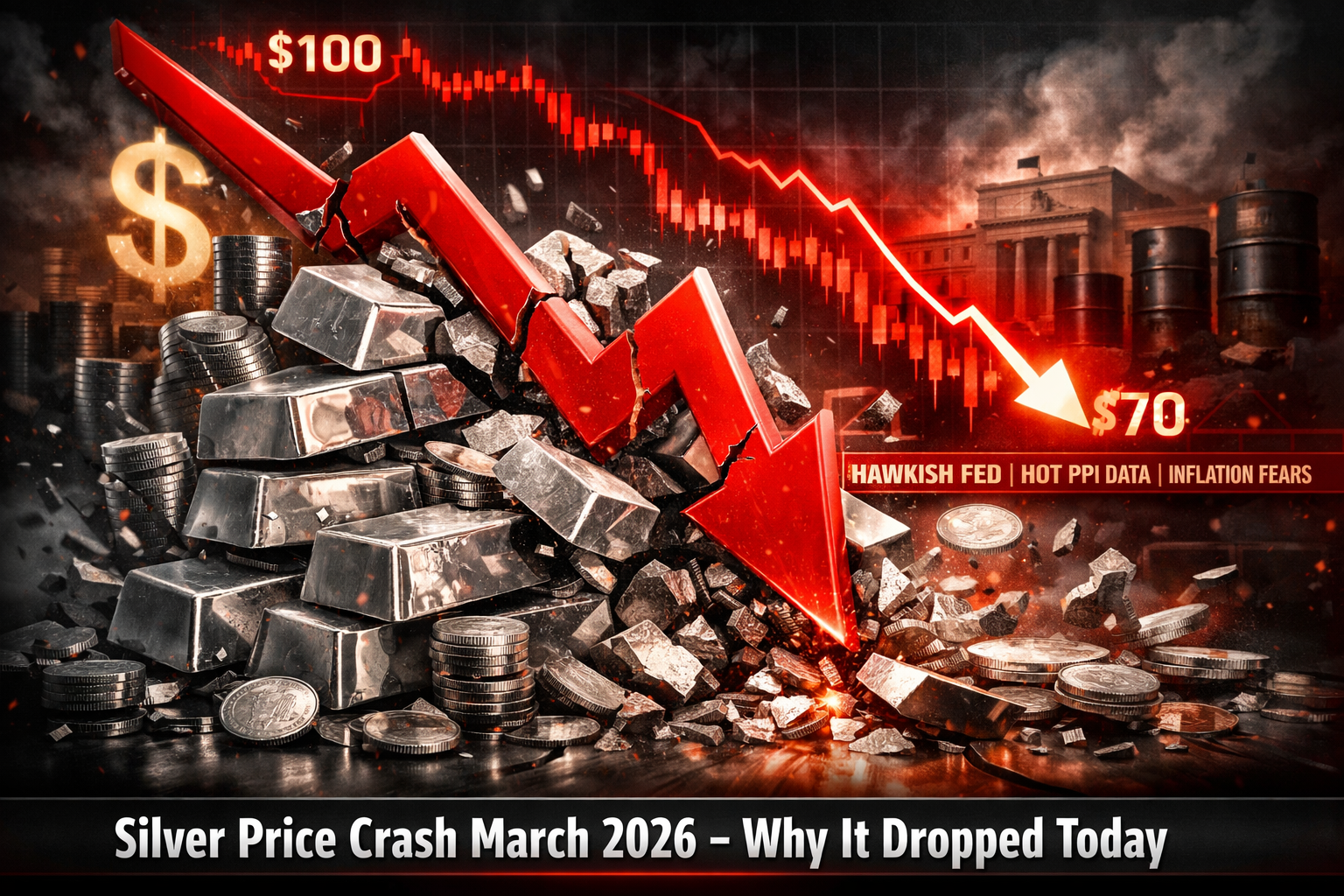
Silver’s March 19 selloff was not just another red day. It was a violent macro-driven repricing event that hit one of the world’s most volatile major commodities at exactly the point where inflation fears, Fed policy, a stronger dollar, high oil, and fragile market structure all collided.
For anyone new to silver, a day like this can feel irrational. Silver has a reputation for explosive upside, so when it suddenly breaks hard, many investors immediately ask the same questions: Is the bull market over? Was this manipulation? Is this just about the Fed? Is physical silver still worth holding if spot can collapse this quickly?
The short answer is that silver remains one of the most emotionally and mechanically unstable major markets in the world. It is not just a precious metal. It sits at the intersection of monetary policy, industrial demand, investor psychology, and very aggressive speculative positioning. That combination is exactly why silver can look unstoppable one month and broken the next.
If you want to track practical real-world values while the market is moving fast, start with our Silver Melt Value Calculator. It is one of the fastest ways to compare what spot is doing versus what your silver may actually be worth by category.
What actually triggered the March 19 silver crash?
The immediate backdrop was hostile for precious metals. Markets were dealing with hotter inflation signals, a Federal Reserve that had just held rates steady while signaling no easy pivot, a firmer U.S. dollar, and energy-driven inflation concerns that reduced the odds of near-term easing. When that kind of setup hits a market as thin and speculative as silver, reactions can become extreme very quickly.
Silver tends to do well when investors believe liquidity is improving, rate cuts are coming, and real yields may drift lower. It tends to do poorly when the opposite happens. On March 18 and March 19, the opposite happened. Inflation concerns stayed alive, oil remained a problem, and the market reassessed how quickly the Fed might be willing to ease.
- Hotter producer-price inflation pressured rate-cut expectations.
- The Fed held rates and did not signal a fast policy pivot.
- The dollar firmed, raising pressure on dollar-priced metals.
- Higher oil prices added inflation fear at exactly the wrong time for silver bulls.
For broader chart commentary and continuing market context, visit our Silver Market Analysis section and our Silver Video Analysis hub.
Why silver crashes harder than gold
Silver and gold are often grouped together, but they do not behave the same way when volatility spikes. Gold is larger, deeper, and more purely monetary in market perception. Silver is smaller, thinner, more momentum-sensitive, and more exposed to shifts in industrial sentiment. That makes silver more violent in both directions.
In practice, silver often has three accelerants working against it during a sharp decline:
- Stop-loss cascades: once obvious support breaks, many short-term traders are forced out automatically.
- Leverage unwinds: silver futures and related speculative positions can get liquidated quickly.
- Narrative reversal: once the market stops believing the upside story for a moment, silver can fall much faster than the underlying fundamentals change.
That is why silver drops often feel more dramatic than the headline catalyst alone would suggest. A macro shock may start the move, but positioning and structure often turn it into a cascade.
Silver’s 2026 volatility did not start today
One of the most important facts many casual observers miss is that March 19 did not happen in a vacuum. Silver had already been through a stunning boom-bust sequence earlier in 2026. Once a market has already shown parabolic behavior, confidence becomes more fragile, technical levels matter more, and every new macro shock lands harder.
When a market has recently gone vertical, the floor tends to become less stable. Traders are less patient. Profit-taking gets more aggressive. Technical damage matters more. Every macro headline hits harder because participants remember how fast the last break happened.
A market that recently went vertical is often more vulnerable to air pockets later. That is especially true in silver, where positioning, liquidity, and momentum tend to dominate short-term price discovery.
What the Fed has to do with silver
Silver does not pay yield. That simple fact is a huge part of the story.
When rates are expected to stay higher for longer, investors can earn more sitting in cash, money markets, and short-duration fixed income. That makes non-yielding assets less attractive on a relative basis. This does not automatically destroy the long-term case for silver, but it can absolutely crush sentiment in the short term.
In other words, silver was not just falling because investors suddenly stopped liking silver. It was falling because the policy backdrop turned less friendly for the kinds of macro assumptions that had helped support precious metals.
The U.S. dollar problem
Silver is priced globally in dollars. When the U.S. dollar strengthens, metals often come under pressure because they become more expensive in other currencies and because dollar strength usually goes hand-in-hand with tighter financial conditions.
Silver does not need a massive macro shock to sell off. It just needs enough pressure to knock the first row of dominoes down. In a leveraged, momentum-heavy environment, even a moderate dollar move can matter.
Oil, inflation fears, and why silver sold off with other hard assets
A lot of investors assume higher inflation is always bullish for silver. Over long stretches, inflation can support hard assets. But in the short run, inflation can actually hurt silver when it leads markets to believe policy will stay tight, real rates will remain elevated, and growth conditions may worsen.
That is what made the March 19 backdrop so dangerous. Oil strength was feeding inflation fears. Hotter producer-price data reinforced those fears. And instead of creating an easy bullish inflation narrative for silver, it reinforced the bearish version: stickier inflation means less policy relief.
In that environment, silver does not trade like a simple inflation hedge. It trades like a stressed macro asset with conflicting identities.
Paper silver versus physical silver: the distinction that matters most
This is where serious stackers separate themselves from chart-watchers.
The silver chart you see quoted minute-by-minute reflects paper price discovery first. That includes futures, derivatives, ETFs, and speculative flows. Physical silver is connected to that system, but it does not always move in a clean one-for-one relationship with it.
Physical buyers still deal with:
- dealer premiums,
- product availability,
- shipping delays,
- buy/sell spreads,
- regional tightness,
- and differences between bullion, jewelry, scrap, coins, and sterling ware.
That means a silver crash on-screen does not automatically mean every physical holder suddenly loses exactly that same percentage in practical resale value. Sometimes the gap between paper and physical widens instead of narrowing.
If you are newer to this distinction, our Silver Education Guide and Silver Education Video Center are built specifically to help bridge that gap.
Long-term fundamentals: why the silver bull case did not disappear today
A one-day crash can damage confidence. It does not automatically invalidate the longer structural case.
The broader silver thesis still rests on a combination of investment demand, industrial use, limited new supply growth, and repeated market deficits. That means there is a meaningful difference between a short-term liquidation event and a genuine collapse in the multi-year silver case.
- Silver remains both a monetary and industrial metal.
- Supply growth has not eliminated structural tightness concerns.
- Physical investment demand still matters when trust in paper assets weakens.
- Short-term volatility does not automatically erase long-term thesis drivers.
That is why serious long-term silver holders tend to ask a different question than traders do. Traders ask, “Why did silver collapse today?” Long-term holders ask, “Did today materially weaken the multi-year supply-demand case?” Those are not the same question.
Industrial demand still matters — even if the market is panicking today
Silver is not only a monetary metal. It remains a deeply industrial one. Even with some substitution and thrift efforts in certain sectors, silver continues to matter in electronics, electrification, advanced power systems, and high-performance hardware.
That makes silver unusual. It can be simultaneously weak as a macro trade in the short term and strategically valuable as an industrial material in the long term.
For more articles around demand drivers and broader silver context, you can route readers deeper into your site through: Home, About, and Contact Us.
What smart physical silver holders usually do during crashes
Experienced stackers usually avoid doing one thing above all else: making emotional decisions off a single day’s chart.
Instead, they often focus on five practical questions:
- What do I actually own by purity and category?
- What is realistic resale value today, not just theoretical spot value?
- Are local premiums compressing, holding, or widening?
- Has my long-term thesis changed, or only short-term price action?
- Am I reacting to fear, or following a plan?
That is one of the reasons a pricing tool is more useful during volatility than a generic chart alone. During straight-up bull runs, people feel rich and stop asking hard questions. During selloffs, they suddenly need precision.
SILVER MELT
VALUE CALCULATOR
REAL-TIME • PRECISE • INSTANT
THE ONLY TOOL BUILT TO SHOW:
practical silver value across real categories:
Coins • Jewelry • Scrap • Bullion
plus realistic buyer ranges for pawn shops, coin shops, refiners, and private-sale logic.
So was this manipulation?
A lot of people ask that anytime silver drops quickly. The truth is usually more complicated than a simple yes or no.
Silver is a market where structure itself can create price moves that feel unnatural. Thin liquidity, leverage, technical trigger points, ETF flows, momentum funds, and stop-loss cascades can all combine into something that looks rigged from the outside even when the move can be explained by mechanics and macro pressure.
That does not mean every move is healthy or intuitive. It means silver is unusually vulnerable to violent, self-reinforcing declines. For most investors, the useful question is not just “Was this weird?” It clearly was. The useful question is “What do I do with that information?”
What matters next
Going forward, there are several things worth watching closely:
- whether inflation cools again or stays sticky,
- whether the dollar keeps firming,
- whether oil remains high enough to keep inflation nerves alive,
- whether silver finds support or keeps cascading lower,
- and whether physical demand stabilizes the market psychologically even if paper price remains shaky.
If macro conditions stay hostile, silver could remain unstable. If inflation cools and rate-cut hopes rebuild, silver can recover just as violently as it falls. That is the nature of this market. It often overreacts in both directions.
That is also why education matters. The better your framework, the less likely you are to confuse volatility with thesis failure.
Bottom line
Silver’s March 19, 2026 crash was a real stress event, not random noise. The market was hit by hotter inflation pressure, a Fed that did not offer an easy pivot, a stronger dollar, oil-driven inflation fears, and the kind of fragile momentum structure that can turn ordinary selling into a cascade.
At the same time, the longer-term silver story did not simply vanish in one session. Silver still occupies a unique place as both a monetary and industrial metal, and short-term panic does not automatically erase the deeper reasons many investors continue to hold it.
For short-term traders, this was a brutal reminder of how dangerous silver can be. For physical stackers, it was a reminder of something equally important: knowing spot is not enough. You need to know category, spreads, premiums, realistic value, and your own strategy.
Keep readers moving deeper into your ecosystem with: Silver Market Analysis, Melt Value Calculator, Silver Education Guide, Video Analysis, and Contact Us.

This content is for educational and informational purposes only and should not be considered financial or investment advice. Market conditions can change rapidly, especially in precious metals. Always do your own due diligence before making any purchase, sale, or investment decision.
Please review our financial disclaimer.
© 2026 925spot.com — All Rights Reserved
