Why Early 2026 Can Be a Smart Time to Start Stacking Silver

The economic backdrop in early 2026
A lot of beginners start thinking about “hard assets” like silver during periods when daily life feels more expensive — even if inflation headlines are lower than they were a couple of years ago.
In the most recent U.S. inflation data available as of this writing, the U.S. Bureau of Labor Statistics reported that the Consumer Price Index rose 2.7% over the 12 months ending December 2025, while core CPI (all items less food and energy) rose 2.6%. Both figures remain above the 2% inflation target commonly referenced by central banks.
For the average household, what matters is not just the headline number, but where costs remain stubborn. In that same CPI report, shelter inflation was reported at 3.2% year-over-year and food inflation at 3.1% year-over-year — categories that directly affect household budgets and keep cost-of-living pressure feeling real even as overall inflation moderates.
At the same time, interest rates remain a major source of uncertainty for both markets and everyday borrowers. On January 28, 2026, the Federal Reserve voted to maintain the target range for the federal funds rate at 3.5% to 3.75%, emphasizing that future policy moves would depend on incoming data and the balance of risks. Rates that are simply “higher than people got used to” can pressure stocks, real estate, and business activity — while also making future policy shifts harder to predict.
Government debt and ongoing borrowing needs are another reason many investors are paying closer attention to store-of-value assets. As of February 4, 2026, the U.S. Treasury Department’s “Debt to the Penny” data reported total outstanding U.S. public debt at roughly $38.56 trillion. Near-term borrowing needs remain large, with Treasury estimates still involving hundreds of billions of dollars in quarterly borrowing, keeping bond markets and long-term rates sensitive to surprises.
Zooming out globally, uncertainty is not limited to one country. A January 2026 update from the International Monetary Fund (IMF) highlighted downside risks including escalating geopolitical tensions, trade frictions, and the possibility of abrupt financial-market corrections if expectations around high-growth themes — such as AI-driven productivity — are reassessed.
Similarly, the World Bank has emphasized downside risks related to continued trade barriers, policy uncertainty, and global economic fragmentation, all of which can disrupt investment planning and supply chains.
That mix — sticky household costs, uncertain rate policy, heavy debt dynamics, and global risk — creates the exact environment where beginners start asking a reasonable question:
“Should I hold some real, tangible value outside of purely digital numbers and paper claims?”

What silver is and why people stack it
What silver is and why people stack it
“Stacking silver” usually means building a personal reserve of physical silver over time — most commonly in the form of coins, rounds, or bars — rather than trying to trade short-term price swings.
The appeal is straightforward: silver is a globally recognized metal with a long monetary history and real industrial utility.
Silver’s industrial role is not a vague talking point. It is central to modern technology. Silver is widely used in electronics and electrical applications, and it plays a major role in solar photovoltaic (PV) technology, largely because it has extremely high electrical conductivity, making it ideal for demanding contacts and connectors.
This PV connection matters for beginners because it ties silver demand to multi-decade infrastructure trends. According to the Silver Institute, solar PV has become one of the most significant and fastest-growing sources of silver demand. The Institute reports that PV’s share of industrial silver demand increased from 11% in 2014 to 29% in 2024.
It also matters that governments increasingly treat minerals like silver as strategically important. In November 2025, the U.S. Department of the Interior finalized its 2025 Critical Minerals List, adding several materials — including silver — based on updated analysis of supply disruption risks and impacts on economic and national security.
The U.S. Geological Survey (USGS) likewise lists silver’s key uses, including electrical circuits and solar cells, reinforcing that silver’s real-world demand is not hypothetical.
There is a second reason people stack physical silver: counterparty risk. Counterparty risk is the possibility that the other party in a transaction fails to perform. The Bank for International Settlements (BIS) defines it plainly as the risk that a counterparty may not fulfill its contractual obligations.
Important inference: a silver coin you physically possess is not someone else’s promise to pay you later. This mirrors how the World Gold Council describes physical gold as having no credit or counterparty risk — and the same logic generally applies to physical bullion-style silver (while still carrying storage and theft risk).
Why silver’s fundamentals look compelling right now
Why silver’s fundamentals look compelling right now
A beginner-friendly way to understand silver’s fundamentals is to ask one simple question:
Is the world consuming more silver than it produces?
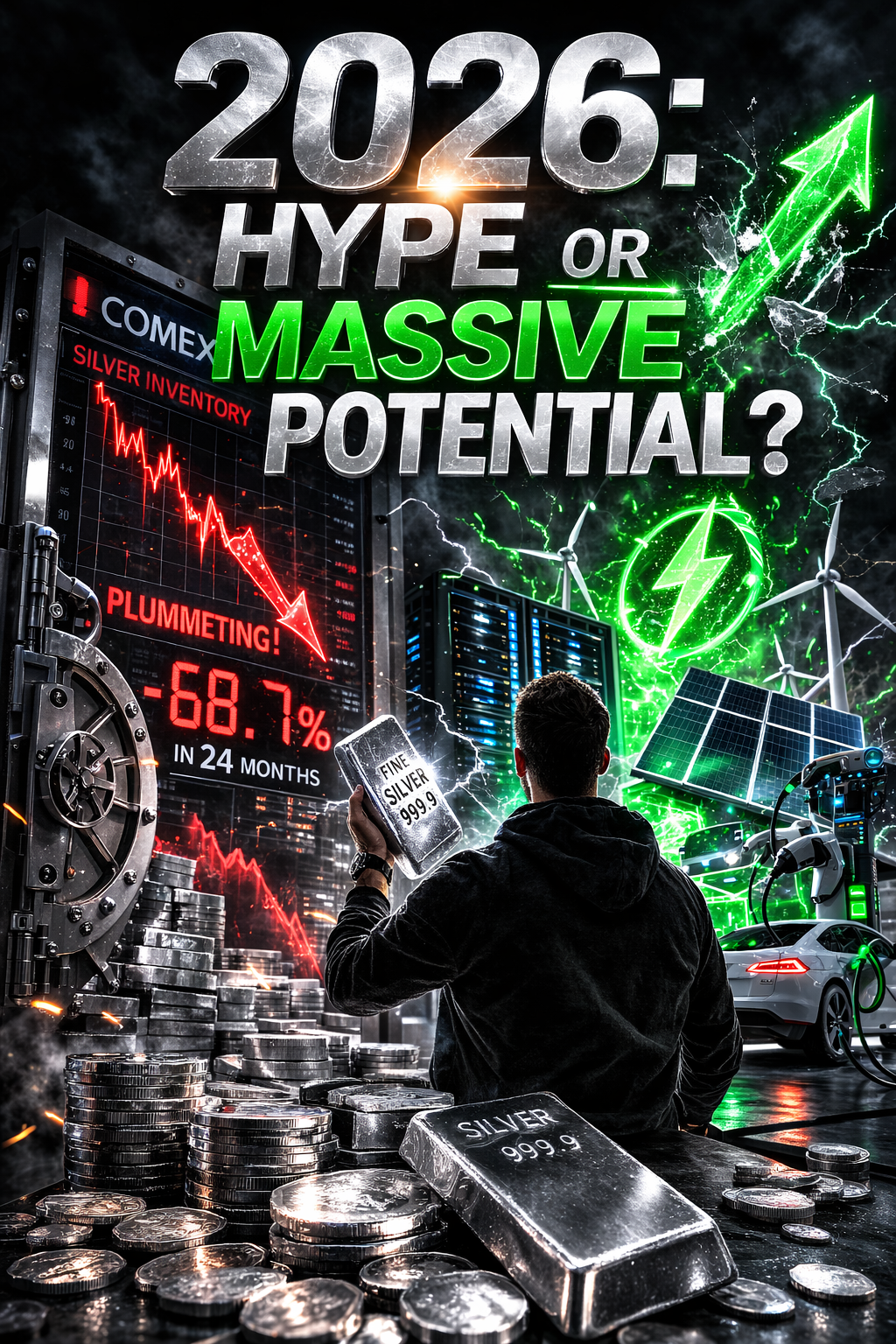
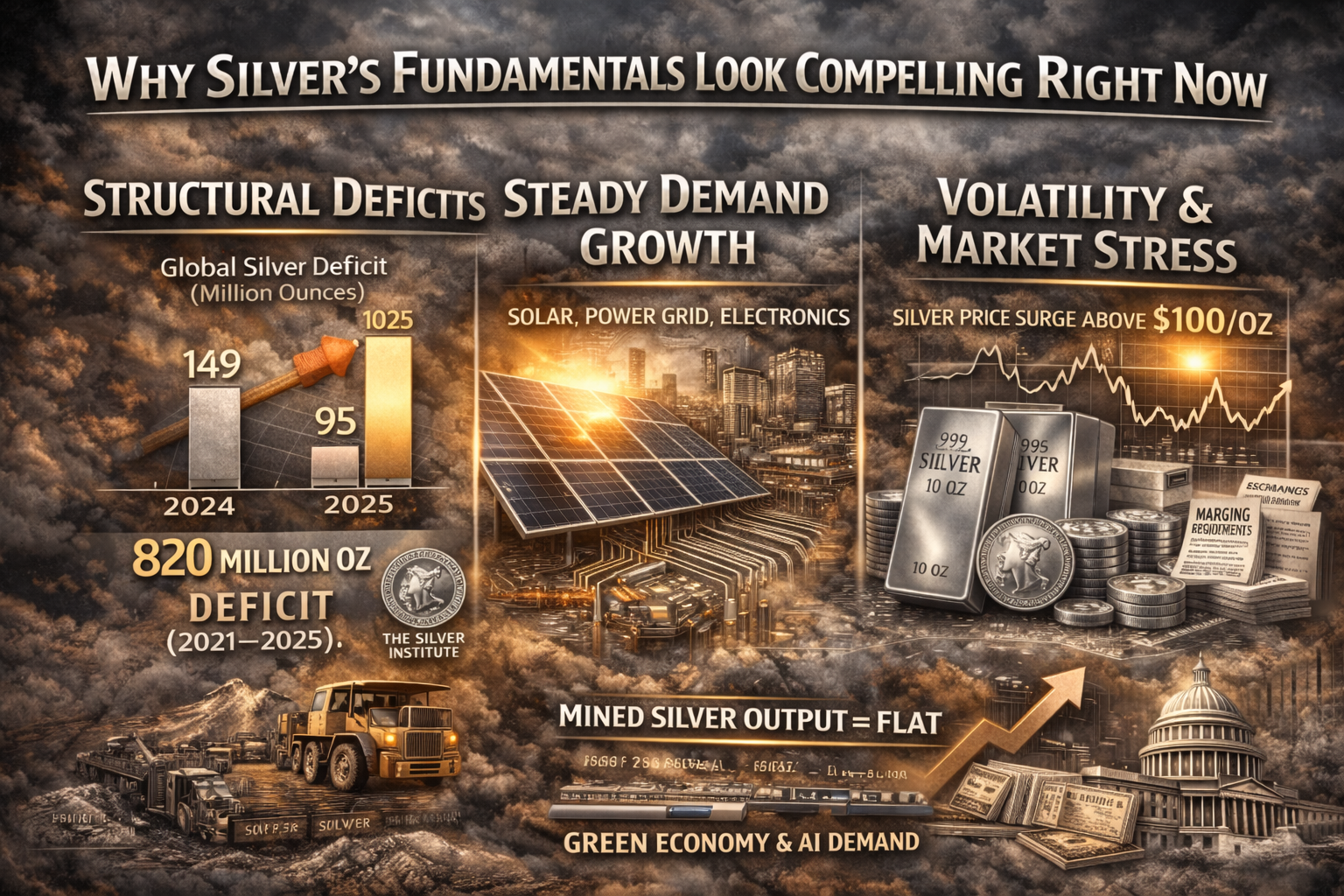
According to the Silver Institute, industrial silver demand reached a record 680.5 million ounces in 2024, marking the fourth consecutive record year. Growth was tied to electrification, grid investment, solar PV, and electronics demand linked to artificial intelligence infrastructure.
In that same reporting, the Silver Institute stated that global silver demand exceeded supply in 2024, producing a structural deficit of approximately 148.9 million ounces.
This is not described as a one-off event. A Silver Institute presentation summarizing 2025 expectations described a fifth consecutive year of market deficit, estimating the 2025 shortfall at around 95 million ounces and citing a cumulative deficit of roughly 820 million ounces between 2021 and 2025.
Importantly, silver demand is not driven purely by investment. It remains deeply tied to industrial cycles that pull metal into the real economy. The Silver Institute highlights that solar installations continue to reach new records — even as manufacturers attempt to reduce the amount of silver per panel through efficiency improvements.
For beginners, this matters because it shows silver demand has both a growth engine (more solar and electrification) and an efficiency headwind (less silver per unit), keeping silver tightly linked to large-scale global buildouts.
On the supply side, the Silver Institute’s 2025 outlook notes that mined silver supply is expected to remain roughly flat year-over-year, with increases in some countries offset by declines elsewhere. Much of global silver production is also byproduct production, meaning supply does not necessarily increase quickly just because silver prices rise.
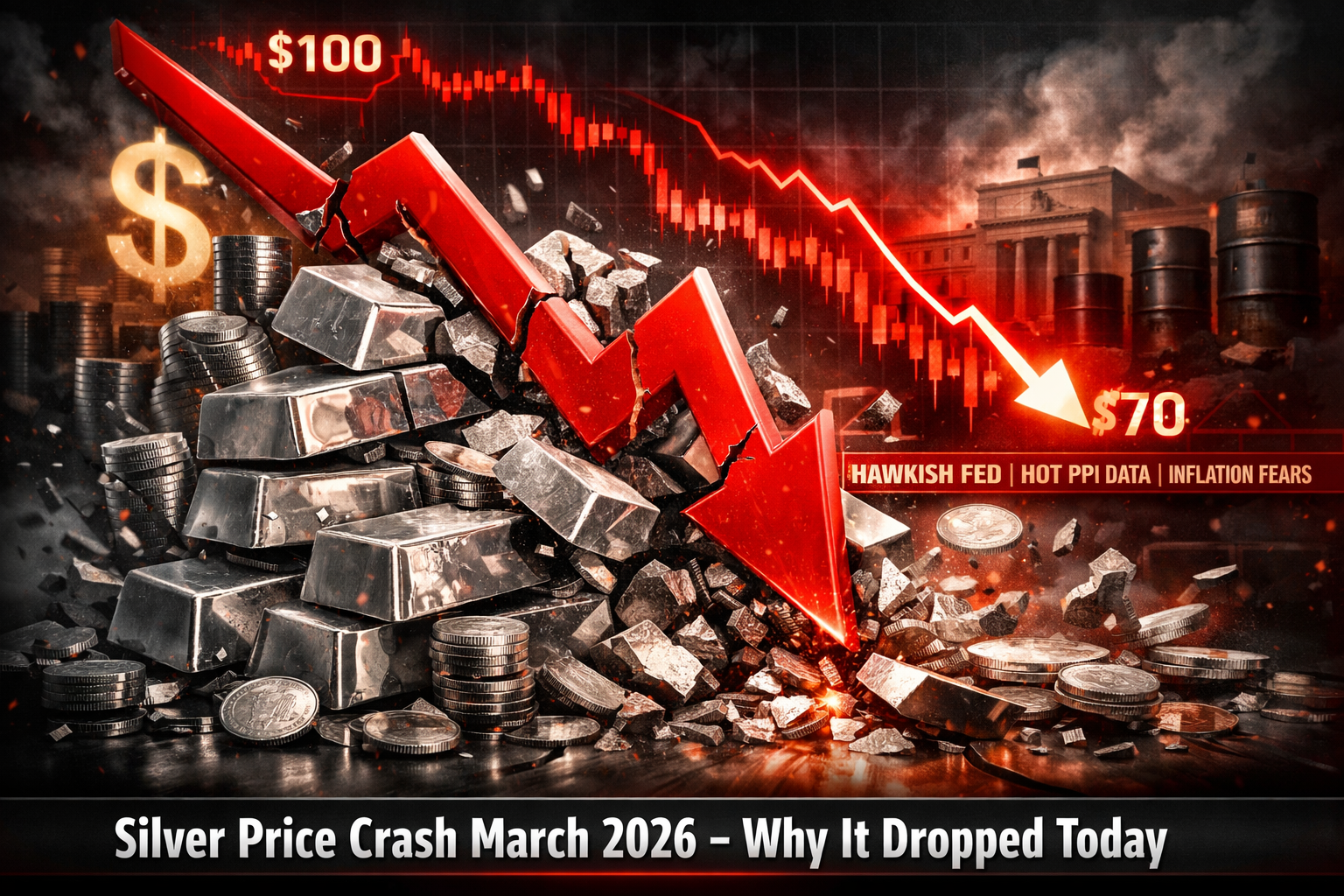
One more near-term factor matters: volatility. In late January and early February 2026, Reuters reported dramatic silver price swings — including a surge above $100 per ounce followed by sharp declines — with futures exchanges raising margin requirements as volatility intensified.
This is not a reason to speculate. For many beginners, it is a reason to adopt a long-term stacking mindset rather than attempting leveraged trading.
A beginner-friendly way to start stacking silver responsibly
A beginner-friendly way to start stacking silver responsibly
If you’re new, the best strategy is usually less about predicting price and more about building a habit you can stick with during stressful headlines.
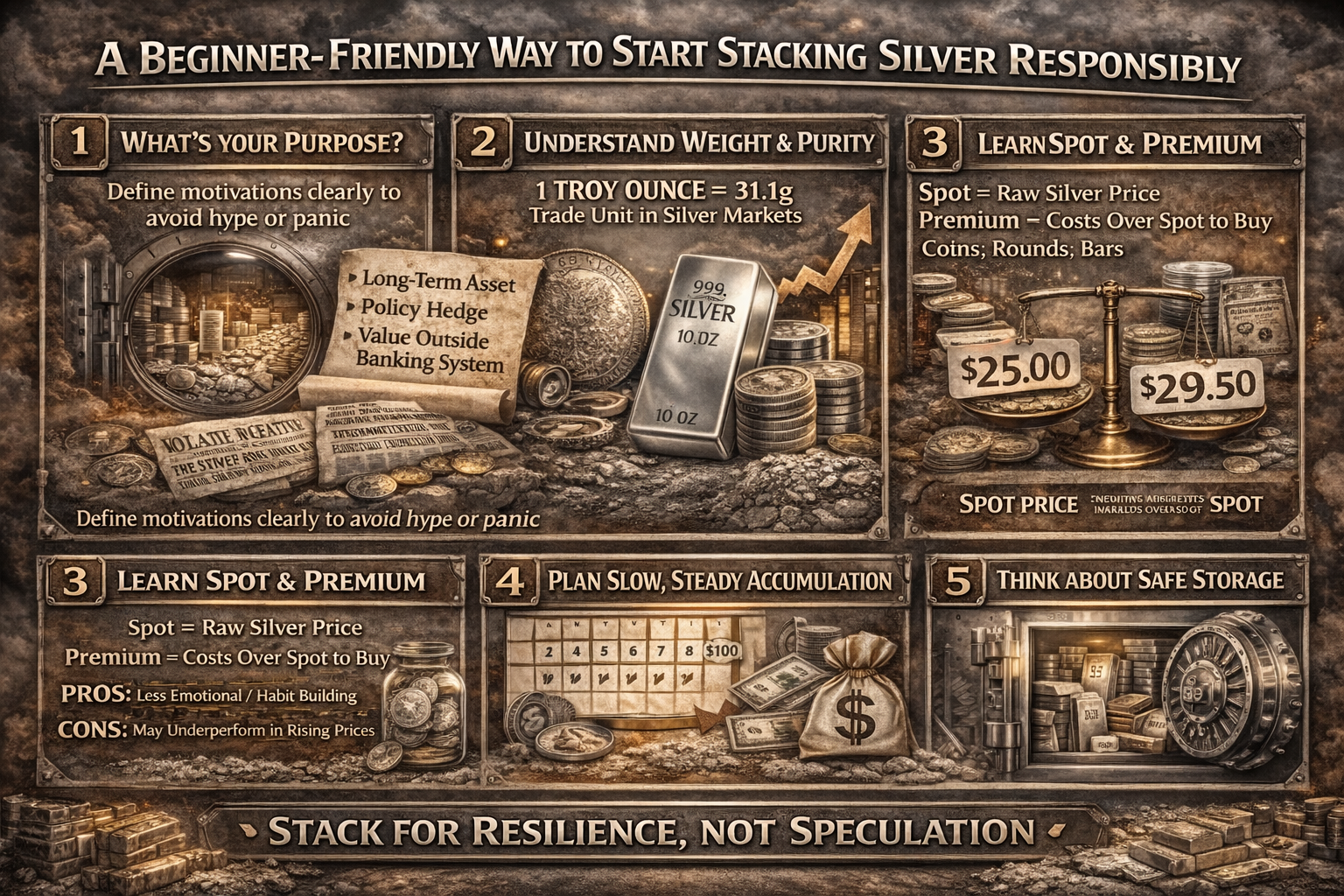
First, clarify why you’re stacking. Most beginners fall into one of three motivations:
A long-term hard-asset position
A hedge against policy or currency uncertainty
A tangible “savings layer” outside the banking system
Both the International Monetary Fund and the World Bank emphasize elevated uncertainty around trade policy, geopolitics, and financial conditions — a backdrop that makes these motivations understandable.
Second, understand units and purity, because this is where many beginners overpay. Precious metals are priced in troy ounces, not standard household ounces. One troy ounce equals 31.1035 grams, which is heavier than a regular avoirdupois ounce.
If your stack includes jewelry, remember that “925” is a purity mark. UK assay offices define a 925 hallmark as 92.5% silver, known as sterling silver.
Third, learn the two prices you will always live with: spot price and premium. Spot is the reference market price for raw silver. The premium is what you pay above spot for fabrication, distribution, and demand. Premiums vary widely by product type and market conditions.
Fourth, plan around volatility, not optimism. Silver can move violently in both directions. Reuters’ reporting on early-2026 price action shows how quickly sentiment can flip. For beginners, this is a strong argument for steady accumulation rather than emotional lump-sum buying.
A commonly used steady approach is dollar-cost averaging (DCA) — buying a fixed dollar amount on a regular schedule. While DCA has trade-offs and does not guarantee profits, it is often used to reduce the behavioral risk of trying to time markets.
Finally, think about storage and insurance early. The Federal Deposit Insurance Corporation (FDIC) clarifies that the contents of bank safe deposit boxes are not insured by FDIC deposit insurance, and banks generally do not insure those contents.

Hypothetical real-life scenarios for beginners
Hypothetical real-life scenarios for beginners
Scenario: The “budget buffer” stacker
Jordan is new to precious metals and doesn’t want to gamble on price. Jordan decides to treat silver like a “hard-asset savings layer” and buys a small amount consistently—similar to a routine savings habit. This approach fits the reality that macro conditions are uncertain: inflation is lower than peak years but still meaningful in daily categories like shelter and food, and central-bank policy is explicitly data-dependent.
Jordan’s win condition isn’t “get rich”—it’s building a tangible reserve over time without letting a single scary week in the market determine everything.
Scenario: The “925 learner” who starts small with sterling
Maria loves jewelry and keeps seeing “925” stamped inside rings and chains. Instead of guessing, Maria learns that 925 indicates 92.5% silver. She also learns the difference between silver jewelry value and bullion value—jewelry can carry craftsmanship premiums that may not be fully recaptured if sold purely for melt. At first, Maria focuses on authenticity (hallmarks) and avoids paying “bullion-level premiums” for pieces priced mostly as fashion.
Over time, she chooses a split approach: she buys some sterling because she likes wearing it, and some bullion pieces because she wants simpler resale pricing. That split makes sense in a world where silver’s demand comes from both industry (PV, electronics) and investment behavior, and where market conditions can change quickly.
Scenario: The diversified investor who wants a “shock absorber”
Devon already has traditional investments and is looking for diversification. Research on precious metals during stress periods suggests they can provide diversification benefits under certain conditions (not always, and not perfectly). Devon allocates a small portion of long-term savings to physical silver not because Devon expects a straight line up, but because global institutions are openly warning about downside risks like trade tension escalation, policy uncertainty, and financial-market corrections.
Devon treats silver as a long-horizon diversifier—fully aware it can drop hard in the short run.
Risks, common myths, and how to stack with clear eyes
Risks, common myths, and how to stack with clear eyes
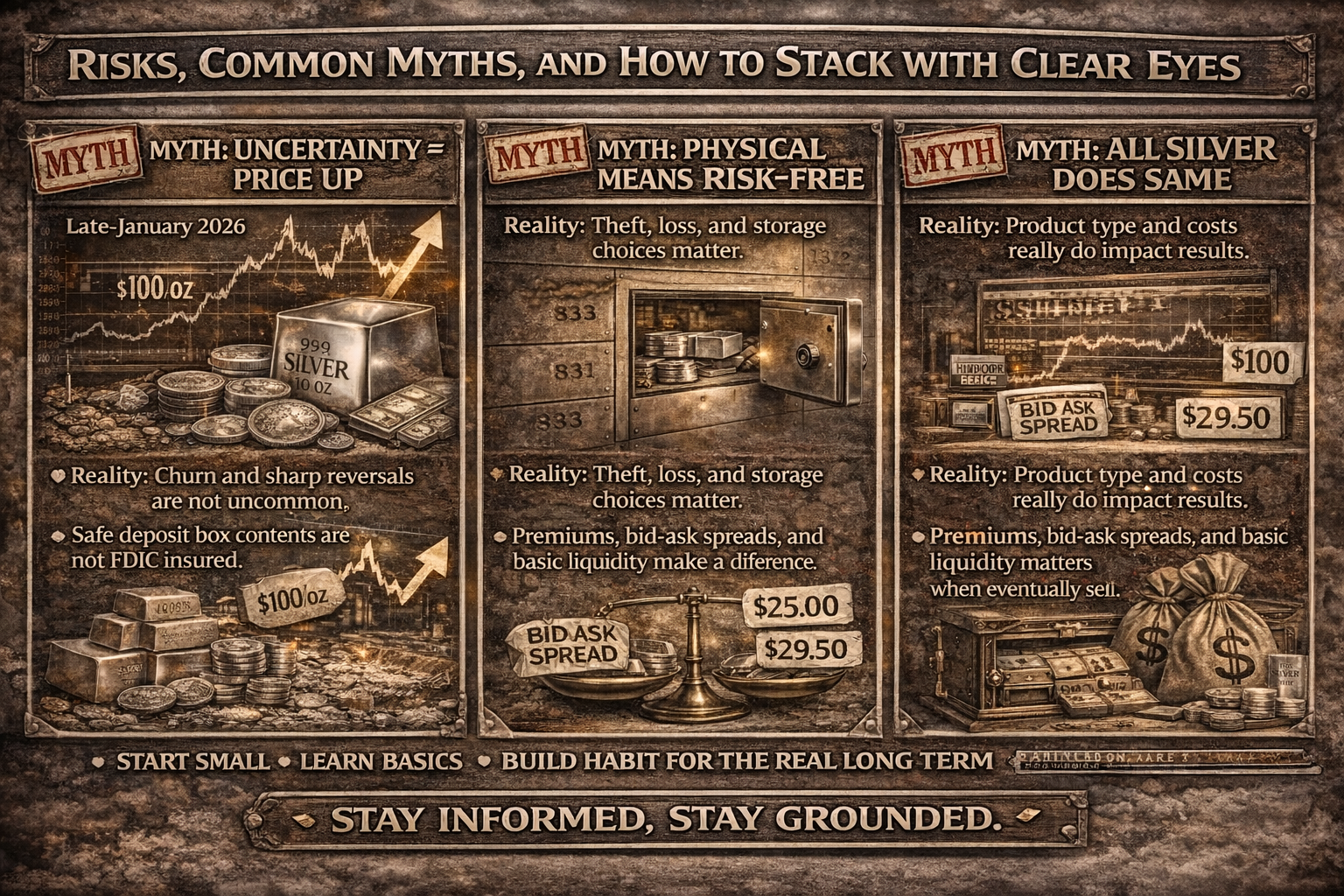
Silver can be a smart addition, but it is not magic. The biggest beginner mistake is thinking “uncertainty automatically means price goes up.” In reality, silver can surge during safe-haven demand and then sell off sharply during profit-taking, leverage unwind, or shifting rate expectations—exactly what Reuters documented during the extreme late-January 2026 swings and the subsequent tightening of margin requirements in futures markets.
A second misconception: “Physical means risk-free.” Physical silver reduces certain financial-system risks but introduces practical risks: theft, loss, damage, and liquidity frictions. The FDIC’s consumer guidance is blunt that safe deposit box contents are not FDIC-insured, and banks generally do not insure the contents—so storage choices should be intentional, and insurance should be understood, not assumed.
A third misconception: “All silver is the same.” In practice, your experience depends on product type and transaction costs. Premiums and bid-ask spreads vary, and those differences can matter more than people expect when they eventually sell. Retail bullion education resources explain that premiums reflect costs and demand, and the “spread” reflects the gap between what buyers pay and sellers ask—part of the real cost of liquidity.
Finally, avoid confusing stacking with leveraged trading. Futures markets can be useful for hedging for professionals, but they can also magnify losses through leverage and margin calls—one reason Reuters reported multiple margin hikes amid early-2026 volatility. For most beginners who want the “sleep-at-night” version of silver exposure, stacking is about slow accumulation and responsible storage, not leverage.
The simplest beginner rule set is: start small, understand what you’re buying (weight, purity, premium), and build your stack like a long-term habit—not like a short-term bet. That mindset aligns with the real macro picture in early 2026: moderating but still meaningful inflation, uncertain rate direction, high debt dynamics, and global risk factors that the IMF and World Bank explicitly flag as material.